
Our Blog

When Your Smile Isn’t Aging as Gracefully as You Are

July 3rd, 2024

You might have been one of the lucky few born with perfectly straight teeth and a healthy bite. You might have spent months in orthodontic treatment as a teenager to achieve perfectly straight teeth and a healthy bite. But now that you’re growing older, you might be unhappily surprised to discover that your smile isn’t aging as gracefully as you are.  What’s changed?

That’s a trick question, because our bodies never stop changing, growing, and adapting. And these constant adjustments include the changes taking place in your teeth and mouth. You might begin to notice subtle differences in your smile when you’re in your thirties or forties. After young adulthood, several factors come into play which can cause shifting teeth and a misaligned bite:

  • Teeth naturally shift.

Shifting can be a result of the normal changes time brings. The periodontal ligaments which attach our teeth firmly to the jawbone lose some of their strength; the jawbones which hold our teeth in place lose some of their density and begin to narrow. Our teeth also have a natural tendency to move toward the front of the mouth, a phenomenon called “mesial drift.”

Add all of these elements together, and your once straight teeth start to crowd together and even overlap—especially the front bottom teeth.

  • Stressful habits stress your teeth.

If you habitually grind or clench your teeth, you’re putting pressure on them. Just like the gentle pressure of braces and aligners can shift teeth into alignment, the more uncontrolled force of grinding can push teeth out of alignment.  

  • Losing a tooth affects surrounding teeth.

Nature abhors a vacuum, and so does your smile. If you lose a tooth, your other teeth will automatically start to drift into the space left open by the missing tooth.

  • A neglected retainer is gathering dust in a drawer somewhere.

You might have spent time as a teenager in orthodontic treatment, with a beautiful smile to show for all your hard work. And, back in the day, your orthodontist no doubt let you know that you needed to keep wearing your retainer at night once your treatment was completed.

If that’s one healthy habit you abandoned as you got older, don’t be surprised if your teeth start to migrate back to their old, less-than-perfect positions.

Between normal biological changes and the wear and tear of daily life, you might find one day that your smile isn’t that same beaming smile you’re used to seeing in the mirror. And it’s not just an aesthetic concern.

Crooked teeth are harder to clean, and built-up plaque means more decay and gum disease. Shifting teeth can cause malocclusions, or bite problems, which can bring you jaw pain, headaches, and chipped or cracked teeth.

If your smile has changed over time, it’s time to give Dr. Cronin a call. There are many discreet options which can return your smile to you, including:

  • Clear aligners—comfortable, removable, and often unnoticeable.
  • Traditional braces—brackets are smaller than ever, and you can choose ceramic brackets which are color-matched to blend in with your enamel.
  • Lingual braces—these braces are attached to the inside of the teeth, for complete invisibility.

And what if you’ve never been as confident in your smile as you wanted to be? There’s good news here as well—it’s never too late to see an orthodontist. Make an appointment at our Langley office to discover how you can make sure your smile looks just as young as you feel!
Electric Toothbrushes vs. Regular Toothbrushes

June 26th, 2024

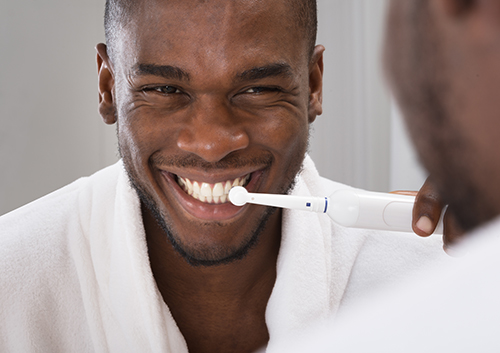
Convertible or sedan? Downtown or suburbs? Electric or manual toothbrush? As life decisions go, it’s certainly not choosing your next car, or deciding where you want to live. But, even when you are selecting a toothbrush, it helps to make a list of the pros and cons of the contenders before you make that final selection.

  • Efficiency

The most important factor in choosing a toothbrush is finding out which model works best to eliminate bacteria and plaque. And studies have shown that, used properly, both electric and manual toothbrushes do a great job of removing plaque. Some electric models can reach the backs of teeth and the gumline more easily, some manual head designs work better for your individual mouth and teeth, so your particular needs should dictate which style of toothbrush you use. Talk to us about the best methods to brush with your preferred toothbrush, and we’ll let you know if one type of toothbrush or the other might work better for you.

  • Health Considerations

Brushing too energetically can actually harm teeth and gums, causing sensitivity and damage to the enamel and gum tissue. An electric toothbrush should provide a continuous brushing motion without needing any pressure from the brusher. This might be the model for you if you have a too-vigorous approach to brushing, or sensitive teeth and gums.

An electric toothbrush can also be more efficient for older and younger brushers, those with limited mobility, and those with health conditions or injuries that make brushing with a regular toothbrush more difficult.

  • Cost

An electric toothbrush is not a one-time investment. You should change the removable head as often as you change your manual toothbrush (every three to four months, please). But this cost is offset if an electric toothbrush is more efficient in removing your plaque, easier to use, or even if you just prefer it to manual brushing. If you find that you brush better and more often with an electric toothbrush, the added expense is well worth it.

Whichever brush you decide on, the most important part of the brush is the person holding it! A regular appointment with your toothbrush for two minutes of thorough brushing in the morning and two in the evening, daily flossing, and regular visits to our office for checkups and cleanings will keep your teeth healthy and strong no matter which toothbrush you choose.

Questions about your toothbrush choices? Don’t hesitate to ask Dr. Cronin at our Langley office.

Avoid Brushing After Every Single Meal!

June 26th, 2024

Here is some surprising yet worthwhile advice you might be hearing for the first time: Brushing after a meal can be incredibly bad for your teeth if you do it after eating certain foods.

Enamel is an extremely hard mineral on the exterior of each of your teeth. It’s actually the hardest substance in the human body: It’s even stronger than your bones! Its only weakness is that acids in the food we eat can easily destroy enamel.

Healthy teeth thrive in an environment that has the proper pH balance. That ensures your mouth doesn’t start the process of demineralization. That’s what happens when alkaline turns into acid, which attacks and softens the enamel on the surface of your teeth. Pores and fissures form, and that’s when the harmful bacteria go to work.

Our mouth’s pH level fluctuates depending on what we eat throughout the day. Examples of the most common highly acidic foods include citrus fruits, soda, and sugary foods. Highly acidic foods tip the balance of pH in your mouth from a healthy alkaline to a dangerous acid.

Can brushing your teeth immediately after a meal lead to even more damage? The answer is yes!

Eating highly acidic foods causes your teeth to be more susceptible. If you brush your teeth when they have been weakened by acids, even more destruction can happen to your enamel. Your toothbrush’s bristles will actually wear away some of your enamel. So it’s healthier to wait at least an hour after eating or snacking to brush.

Good preventive measures to take instead of brushing after you eat include:

  • Rinsing or drinking water
  • Chewing sugarless gum
  • Consuming dairy or non-acidic foods to conclude your meal

These practices help produce saliva, which in turn restores a healthy pH level in your mouth and coats the teeth with minerals they need.

Once you’ve allowed time for your mouth to be restored to a healthy pH level, you may brush your teeth as you normally would. Keep in mind that acidic foods can weaken the enamel on your teeth and take the right measures to prevent spiking pH levels.

Most important, don’t forget to wait to brush at least one hour after you eat!

Still have questions? Call our Langley office and schedule an appointment with Dr. Cronin.

Hey, Metal Mouth, Hey, Train Tracks! Six Funny Comebacks for People Who Wear Braces

June 19th, 2024

Brace-ism: believe it or not, it’s a concept. The Urban Dictionary defines brace-ism as “acting mean to people who have braces on their teeth.” Phrases like metal mouth, brace face, and train tracks are common jokes uttered by gap-toothed fools who like to make fun of people with braces.

While ignoring these comments and taking the high road is the best thing to do, there’s nothing wrong with having a few clever retorts and quick-witted comebacks up your sleeve.

  1. The next time someone calls you train tracks, break into an obnoxious train imitation, with lots of toot-toot and chuga-chuga-chuga. Finish off your crazy locomotive impersonation with some sort of deafening train horn. That’ll keep the bullies at bay.
  2. “It’s better to be a brace face than a space case.”
  3. Counter with a ridiculously childish joke that makes the schoolyard tormentor feel even smaller than he already is. “Oh. Yeah. Why did the deer need braces? Because he had buck teeth. Hahaha.” Top it off with an exaggerated eye roll.
  4. “Yeah, my brother tells that joke. He’s six. You guys should hang out.” That’ll stop the haters dead in their tracks. Or would that be train tracks?
  5. Here’s one from the sarcasm grab bag. “Well, I’m just glad there’s a way to fix what’s wrong with my face.”
  6. “I can’t wait to discuss this formative moment at our ten-year class reunion, when my teeth are razor-straight and you’re wearing adult braces.”